
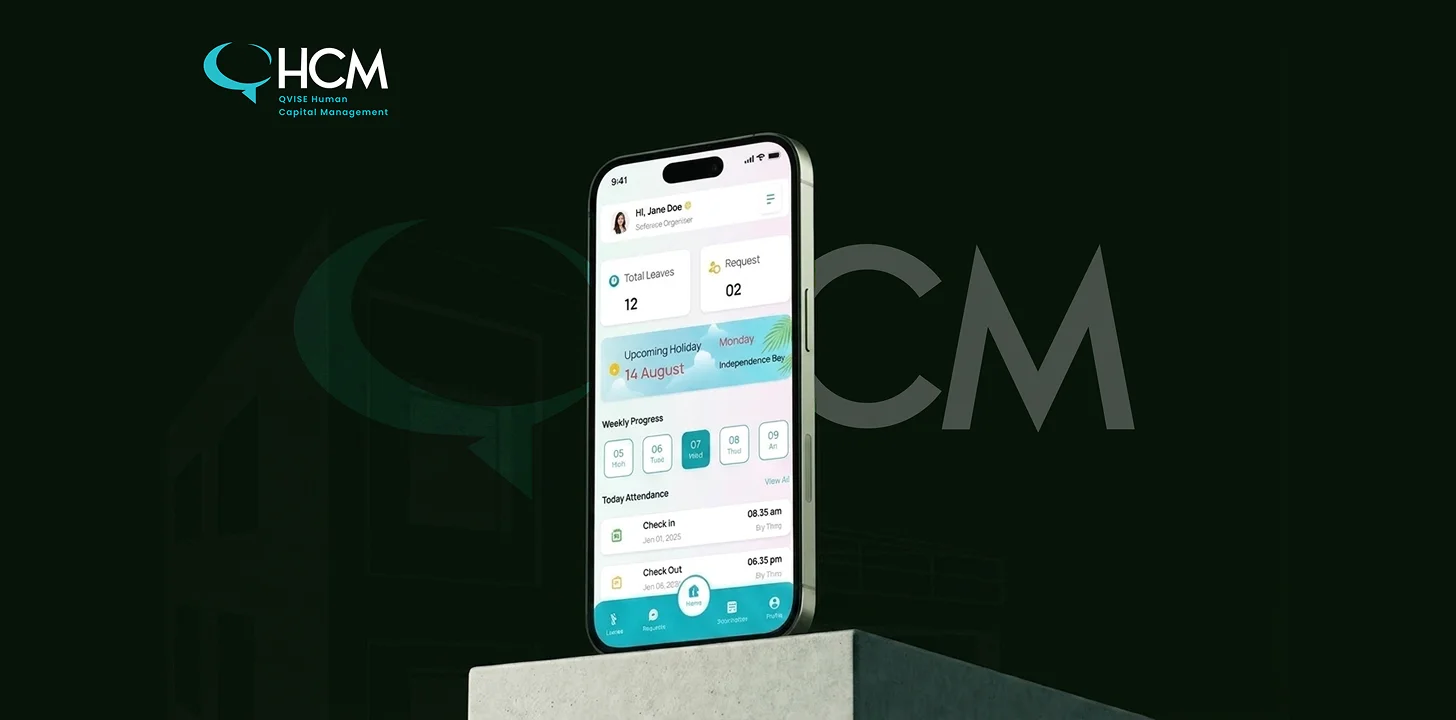
QHCM Qvise
Qvise operates across Karachi, Dubai, and Saudi Arabia, and needed an HR platform that could run more than one company entity from the same system — without one company’s data, staff, or settings ever bleeding into another’s. That requirement shapes almost everything else: shift patterns, leave policies, and reporting all needed to work company-by-company, while still giving admins a consolidated view across the group when they needed one.
Client
Qvise (Quality Vertex Integrated System Engineering Pvt. Ltd.)
Sector
Defence & Commercial Engineering / Integrated Logistics Support
Location
Karachi, Pakistan (HQ), with offices in Dubai, UAE and Saudi Arabia
Services Provided
Design & Development (App Development), Consultancy & Architecture
The challenges
One HR System, Several Companies, No Shortcuts on Control
As a regulated legal practice, the firm also had specific expectations around data security and continuity that a straightforward lift-and-shift wouldn’t satisfy on its own. The brief wasn’t just to move infrastructure to the cloud — it was to do so without interrupting active casework, and to leave the firm in a stronger security and resilience position than the on-premise setup it replaced.
On top of the multi-company requirement, the brief covered the full employee lifecycle end to end — from a department raising a hiring request, through interviews and onboarding, to day-to-day attendance and leave, project and task tracking, and eventually offboarding — all governed by role-based access so that an employee, a manager, HR, and an admin each see only what they should.
Manual or spreadsheet-based HR processes don’t hold up at that level of complexity. Qvise needed a single, structured system — not a patchwork of trackers that only stayed accurate as long as someone remembered to update them.

#Data Leaks, #Access Risks, #Lost Context, #No Audit Trail

#Data Leaks, #Access Risks, #Lost Context, #No Audit Trail
The Approach
Map the Full Employee Lifecycle, Then Build It Company by Company
1 Requirements & System Architecture
We worked from a detailed specification covering 19 functional areas — hiring and onboarding, employee records, leave, shifts, biometric attendance, projects, company and department structure, role and permission management, assets, reporting, notifications, audit logging, and offboarding — and translated it into a system architecture built around one core rule: every module had to respect company-level data isolation from the ground up, not as an afterthought.
2Core HR & Workforce Modules
We built the employee lifecycle as a connected flow rather than separate tools: a manpower request from a department triggers HR review, job posting, shortlisting, interviews, and final selection, which then creates the employee record, assigns their role and department, and generates system access automatically. From there, leave, shift assignment, and biometric attendance (fingerprint or facial recognition) all link back to the same employee and company record, so working hours, leave balances, and shift rules stay accurate without manual reconciliation. Project and task management sits alongside this, letting managers assign work, track completion, and flag overdue tasks per project, department, or employee.
3 Access Control & Security
Role-based access control runs through every module — Admin, HR Manager, Manager, Employee, and Guest each have a distinct, enforced set of permissions, and roles can be scoped at group or company level. Every meaningful action — company creation, role changes, biometric attendance corrections, status changes on resignation or termination — writes to an audit log, so there’s a traceable record of who changed what, and when, without relying on anyone’s memory.
The Outcomes
A System That Scales with the Company, Not the Spreadsheet
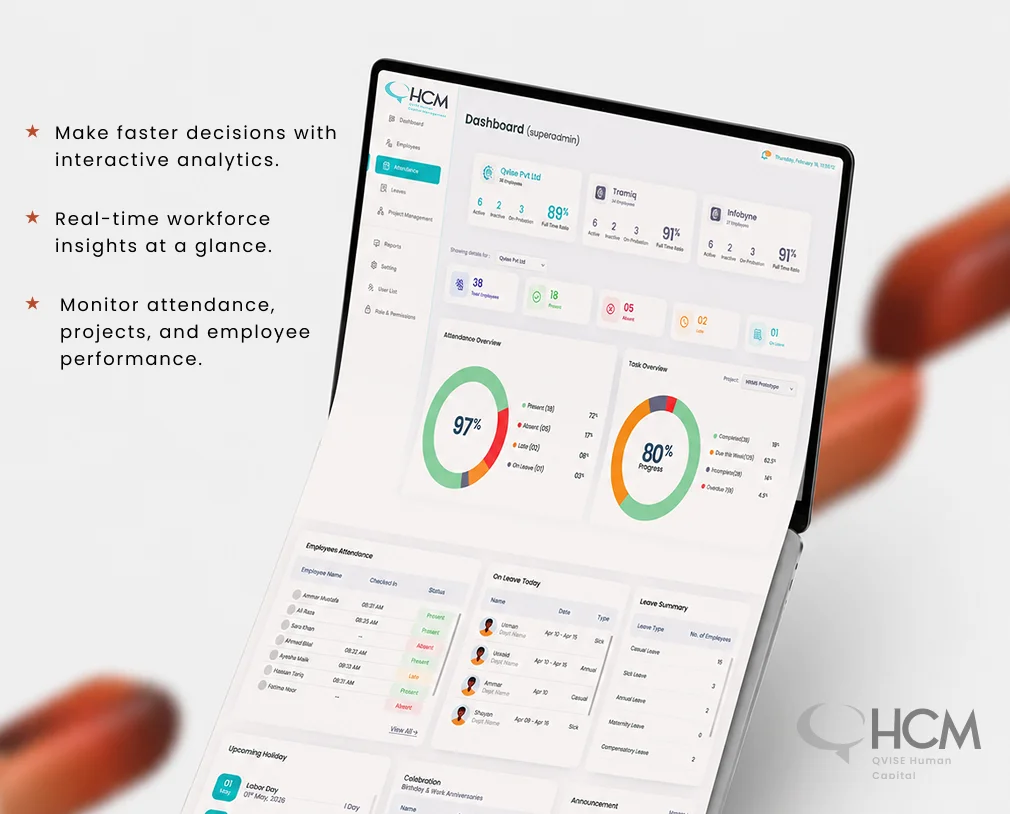
Qvise now runs hiring, attendance, leave, shifts, projects, and reporting for multiple companies across Karachi, Dubai, and Saudi Arabia from a single platform, with each company’s data properly isolated and each role seeing exactly what it should. Employee status — active, on leave, resigned, terminated — drives system access automatically, so onboarding and offboarding no longer depend on someone remembering to update permissions manually.
Biometric attendance removes proxy clock-ins and feeds directly into leave and reporting, and every major action across the system is logged for audit and accountability. The result is a platform that can add a new company, department, or role without needing a redesign — the structure was built for that from day one.

Multi-company from day one
One platform running shifts, attendance, leave, and reporting separately for each company, with data isolation enforced at every level.

Lifecycle, automated
Hiring, onboarding, role assignment, and offboarding flow through the system end to end — not tracked across spreadsheets.

Fully auditable
Every status change, role update, and biometric correction is logged, giving a clear record of who changed what, and when.
Ready to Build Software That Fits Your Industry, Not the Other Way Around?
Tell us about your sector — we’ll show you what we’ve built for teams like yours