
Infobyne Sling Chat App

Client
Infobyne
Sector
Full-Service Creative & Digital Marketing Agency
Location
Karachi, Pakistan
Services Provided
Design & Development (App Development), Consultancy & Architecture
The Challenge
Internal Communication That Needed Permission Built In, Not Bolted On
As a full-service creative agency running concurrent client projects — web development, branding, content, video, social, and SEO all at once — Infobyne needed an internal communication tool that matched how the business is actually structured, not a generic team chat app configured after the fact.
Two requirements shaped the brief. First, access had to be permission-based from the ground up: employees shouldn’t be able to message anyone outside their authorised hierarchy, unauthorised contacts shouldn’t even appear in a directory search, and communication across company boundaries needed explicit approval rather than being open by default. Second, project accountability needed to live inside the same platform — with multiple people working across multiple client projects at once, Infobyne needed a straightforward way for every employee to log daily, project-wise task entries and hours, without relying on a separate spreadsheet nobody kept up to date.
The Approach
Build Permissioning and Reporting into the Platform, Not Around It
Access Architecture & Role-Based Permissions
We built the system — internally named Sling — around JWT-based authentication and role-based access control from the first design decision. Company data is isolated by default, with cross-company communication requiring explicit approval rather than being open. Within a company, contact visibility follows the org chart: Superadmins, CEOs, and CTOs can see across the full directory, Directors and Managers see their own company's leadership and staff, and employees see colleagues within their own company. One deliberate exception: if a CEO or CTO messages an employee directly, chat access is granted automatically, so leadership can always reach anyone without waiting on a permission request.
Real-Time Messaging & Workspaces
Direct messaging supports real-time delivery, audio/video calling, voice recording, and file and link sharing, with the ability to pin or bookmark important conversations for later. For team and project collaboration, workspace groups bring the same capabilities — team chat, announcements, shared files, pins — into a shared space scoped to the people actually working on that project, rather than a single company-wide channel where relevant conversations get lost.
Visibility, Notifications & Task Reporting
A company directory lets people search colleagues based on what their role is allowed to see, notifications cover new messages, mentions, pins, and permission approvals, and every login, message, call, and permission change is written to an audit log. Alongside communication, the Report Task module gives every employee a simple way to log daily, project-wise task entries and hours worked — including backfilling previous dates — so project accountability sits inside the same tool people are already using to communicate, rather than a separate system.
The Outcome
One Platform for Communication and Accountability, Scoped the Way the Business Actually Works
Infobyne now runs internal communication through Sling with permissioning enforced by default — nobody sees or messages a contact they’re not authorised to, and cross-company conversations require sign-off rather than happening by accident. Leadership retains the ability to reach anyone directly, workspace groups keep project conversations contained to the people working on them, and every meaningful action is logged for audit.
Daily task reporting sits inside the same platform, giving Infobyne a simple, always-on view of who worked on what, for how long, across every live project — without a parallel spreadsheet process competing for people’s attention.
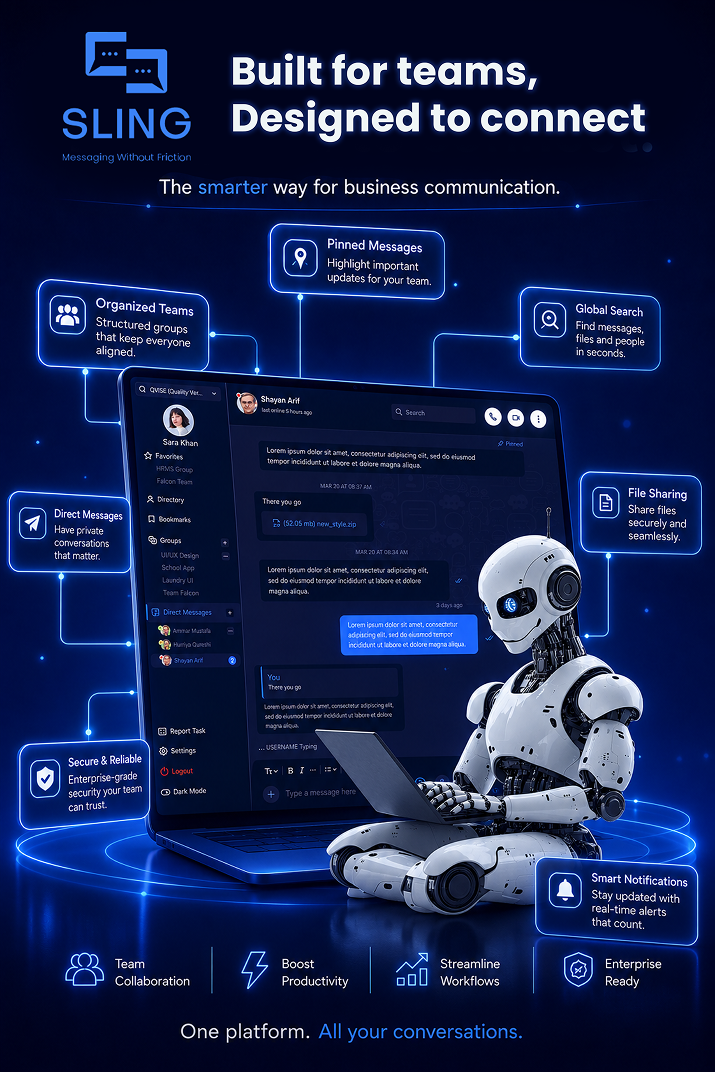
Permission-first by design
Unauthorised contacts don't appear in searches or directories — access is granted deliberately, not assumed.
Multi-company, isolated by default
Company data stays separate unless cross-company communication is explicitly approved.
Daily reporting, built in
Every employee logs project-wise task entries and hours in the same app they already use to communicate.